NaZmiUS ORIGINALITY


The daily Jordan Times (24/3/2005) :


The following article by Dr. Omnia Amin as it appeared.


WORD/  books . literature . ideas


LITERATURE/ Tayseer Nazmi looks for the unfamiliar and the unusual in his writing. As a result he is often misunderstood Dr Omnia Amin says.


Nazmi and the improbable burdens of life


Dr. Omnia Amin


 TAYSEER NAZMI HAS been writing since he was 20 years old .His early writings caused much controversy when they were published as he was always after the unfamiliar and the improbable ,which he always thought were never out of reach .A


lot of fantasy is involved in his creative writing, but Nazmy is more known as a critic in the literary and cultural field in the Arab World .


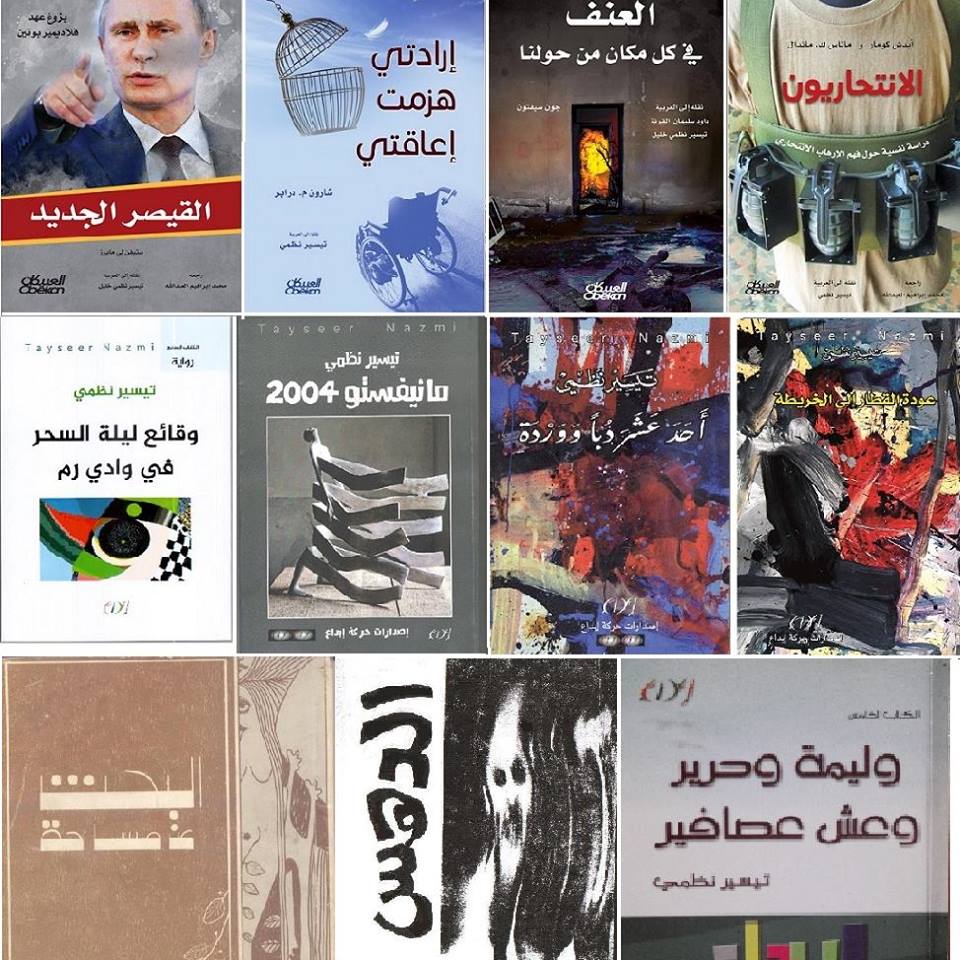
He has a piercing vision that responds to the effects of life from an angle that needs a special person with a sensitive perception to understand .More often than not he is misunderstood and misinterpreted as he avoids the familiar in search of different shores. Nazmi is a creative writer, a critic and a translator and has several books that are at the moment pending publication .The following short stories are taken from his collection entitled A Feast ,Silk and A Bird's Nest published by Al Karmel Press in 2004 and sponsored by the Greater Amman Municipality.


An idea, Two Drunkards and A Door (One short story in 5 parts,by Tayseer Nazmi . Translated by Dr. Omnia Amin)


At Night without the Night  


  The two drunkards, the owner of the house and his friend suddenly became aware. It was an hour after the people entered their house and they greeted themselves.It was after they went to the kitchen and ate what food remained from dinner: Lentils, bread, onions and garlic. After that they served themselves cheap arak and then they excused themselves politely as one of them took the new tape of Fairuz's songs and left. In this manner they both became aware of the question. After a long silence in which they thought , drank and listened to songs, one of them said to the other: " Will they come back to continue the night with us?" The other said: "I don't know". The first enquired: "Do you happen to know them? The second said: "No …do you?" The first said:" No, I've never seen them before." They continued to drink as if nothing had happened and they both wished the visitors had stayed for a while longer and they all sat and shared this long night .The door was still kept ajar, or may be open , but they were too occupied to think of that and too occupied to think of all they feared like for instance their bottle becoming empty or running out of cigarettes in the night. Drunkards are always like that and the night doesn't share anything with them .They are always like this only at night, without the night.  


The Importance of Getting Married  


  With difficulty, and after many tiring enquiries and readings, I got the address of death. Using my wit that brought me a lot of trouble in life, I chose night-time to visit him and to gently knock at his door. I thought that such secrecy would allow me to achieve my final goal and catch him at home after he was through with the world of a tiresome day. But the first time I knocked his door I found him asleep. Maybe he was tired and fast asleep, so I closed the door and returned extremely depressed. The second time I went a bit early and found him at the doorstep about to enter his house .When he saw me he asked me to leave immediately and to give him three days. I found that it was somewhat too long and boring. Waiting weighed heavily on my heart after so much yearning. I was surprised to find after the three days passed that he was warning me and asking me to occupy myself with life. He even advised me to go ahead to the person I wanted to marry months ago and to give it a final try for I might succeed in getting married and setting down and I wouldn't  be in need  of him. Maybe he bet that I would forget the address, his address of course. I obeyed his orders and went looking my best and keeping patient, preparing myself to forget the idea. When I knocked on his door his wife answered me saying:" Excuse me I am his wife, Life. He asked me to tell you that you in particular have to forget him", and she shut the door.


Sun


My problem is that I always wake up. I get up and start my day with what has become too familiar, repetitive and boring. I stay up till late , I get tired and desire sleep. The minute I enjoy sleep and quiet, I find myself waking up for no reason. Is it the sun for instance? Of course not, for this happens to me also in winter time when dark clouds hide the sun. It seems I have no solution for this problem. Every day I start my day I feel lazy to arrange my things. I hope that long sleep will rid me of them and of seeing them, but sleep evades. Therefore, I found no other way except to defeat the deceitful sleep by waking up till death.


The Idea


The two drunkards were amazed by the idea but they decided to prepare for it with enough amounts of cheap arak so they could drink to death. And I, the one who came up with the idea decided not to give sleep a chance so that he remains a sleep in my bed and hands me over to oppressive awakening. As for death, he was found dead in his bed for it seems that his marriage wasn't legal and his wife, Life, was pregnant. She told the two drunkards and me: "Give me time until I deliver my baby so that I can accompany you for I too have come to believe in the idea".


The Door


The door too was fed up with time and with the two drunkards and those entering and leaving. It got tired of being kept ajar and got fed up with the pregnant woman, her dead husband and of continuing to be a door. It left and went to the forest without knowing that the forest itself had left by force to the city and was turned into office furniture and doors closed on hatred, deceit, oppression, forgery, swindling, hypocrisy, bribes, stealing, robbery, lies, marital deceptions, political conspiracies and party meetings. Finally the door reached its country of origin only to find a huge void. It remained lonesome in the desert .No doubt that over there it forgot the idea without pretending to. After a long time in the desert after it lay down, slept without a forest, without a home, without locks and without hands to close it and open it, without those entering and those exiting, it no longer was a door.


Translated by Dr. Omnia Amin

تيسير نظمي يعيد نشر قصة من قصصه كتبها قبل ثلاثين سنة


صالح صلاح يتسلم رسالة من والده


قصة أهداها تيسير نظمي لمحمود درويش في مجلة الآداب مغايرة لأحمد الزعتر العربي


أحمد حسن


القصة القصيرة الفلسطينية تنبأت بالانتفاضة قبل ست سنوات من حدوثها بقلم:تيسير نظمي


الطبــــــوش


من صباح الخير يا فاكهاني إلى صباح أم الخير..جدلية العراقي والفلسطيني مستمرة بقلم:تيسير نظمي


صباح الخير أم الخير


قصة أخرى من كتاب الدهس 1982 بقلم: تيسير نظمي


حميد يدخن سيجارته بهدوء


حداثة القصة الفلسطينية قبل 32 سنة وتخلف اليوم بقلم:تيسير نظمي


حلم العصافير مضى


كان طفـــلاً بقلم: تيسير نظمي


كان الصعيد غافيا بقلم: تيسير نظمي


آن له أن ينفجر بقلم : تيسير نظمي


فاطمة الجميلة أكثر بقلم : تيسير نظمي


كبش بلا أسنان بقلم : تيسير نظمي


As Big as Mount Ararat


Marc Edward Hoffman


"You son of a bitch, you're a traitor, trying to buy me out with American money! There's no way I'll leave the Workers' Party. Get the fuck out of here, and don't speak to me ever again!" He waves his arm dismissively, with a hint of menace, his one eye pinched in such theatrical disgust that for an instant it resembles the shriveled, sunken flesh that fills the socket beside it. Then a sliver of silence. He sits there, still and staring, trying to gauge my reaction. Suddenly Yashar Kemal erupts in laughter. Full-throated, full-bodied, convulsive laughter. Now his eye is wide and shining. Forty years on, rebuffing an invitation to fortune and fame in the United States strikes Turkey's greatest novelist as nothing short of hilarious.


Kemal and I are sitting in his Istanbul apartment, watching the sun set across the Bosphorus, and he's recalling how, in the 1960s, a CIA agent—who till then had been a friend—suggested that his books might be more popular in the United States if he quit the Turkish Workers' Party, a Marxist organization for which he was the leading propagandist. As his re-enactment indicates, Kemal took offense at the suggestion, and huffily refused. The agent says that he never meant to dictate Kemal's politics. Indeed, he doesn't recall the incident at all, and seems genuinely dismayed at the author's recollection of events. (There's no denying that Kemal is a raconteur.) But the stubborn fact is that, for whatever reason, Kemal has never gotten the kind of recognition in the New World that he has in the Old, where for several decades he was considered a front-runner for the Nobel Prize.


Nowadays Kemal has largely been forgotten, at least in the West, where he's been eclipsed by Orhan Pamuk. When Pamuk received the Nobel in 2006, the Swedish Academy hailed him for transforming Istanbul into "an indispensable literary territory, equal to Dostoyevsky's St. Petersburg, Joyce's Dublin, or Proust's Paris." That's a fair judgment, but the same could be said for Kemal's portrayal of the Cukurova plains, where most of his works are set, and which critics have rightly compared to William Faulkner's Yoknapatawpha County and Gabriel García Márquez's Macondo. Many Turks argue that Pamuk benefited from a stroke of luck, or rather a gust of political correctness, when the academy honored him as a rebuke to the Turkish government for putting him on trial the year before, on charges of "publicly denigrating Turkish identity," after he'd referred to the massacre of "30,000 Kurds and 1 million Armenians" in an interview with Das Magazin. That, too, is a fair point, but many other writers—including Kemal—have been prosecuted under the Turkish penal code for their impolitic statements about Kurds or Armenians. But none of those writers drew attention to themselves, as Pamuk did, by falsely boasting, "almost nobody [else] dares mention it."


If Pamuk is Turkish literature's face—or at least the face that it turns to the West, and that the West finds most flattering—then Kemal is Turkish literature's heart and conscience. While Pamuk may speak for members of Istanbul's urbane, secular elite, it is not at all clear that they, as a class, speak for the whole of Turkey. Indeed, the country's past several election cycles would seem to indicate otherwise: it's the pious arrivistes who are in charge. To really understand Turkey, one must try to understand them. And while Yashar Kemal doesn't speak on their behalf—he is, after all, a communist, and religion plays little role in his novels—he at least writes about the social circumstances in which they, or rather their constituency, have toiled and grown. Grounded in the soil of rural, south-central Turkey, where Kemal was born and raised, his greatest novels, such as his classic, Mehmed, My Hawk (1955), focus on peasants' and former nomads' struggles to adapt to a changing world. Writing in an epic, almost mythic mode, with characters and themes derived from folk tales and the songs of Anatolian bards—but with an attention to physical detail and social relations that recalls Tolstoy—Kemal depicts the profound disruption of village life brought on by mechanization, market economics and the wholesale transformation of the countryside. His oeuvre traces Turkey's remarkable evolution over the past century from a multiethnic, polyglot, post-Ottoman rump state—one without a clear identity or natural cohesion—into a modern, if still rather disunited, nation.


The man who would come to be known as Yashar Kemal was born Kemal Sadik Gökceli in Hemite, a village in Cukurova ("the hollow plain"), one of Turkey's most fertile agricultural regions, probably in 1923—the year of the republic's founding. (It's impossible to know the exact date of his birth because there's no record. To this day, many births in the Turkish countryside go unrecorded.) His parents were Kurds who had fled eastern Anatolia, where they were landowners, during the region's occupation by the Russian army in 1915. His father's uncle was the last chief of the Luvan tribe; by the standards of the time and place, his family was wealthy. The village where they settled consisted of about sixty houses, simple adobe structures with thatched roofs and dirt floors packed and covered with kilims. The other residents of the village were descendants of Turkoman nomads who had been settled there in 1865 after their rebellion was crushed by the Ottoman state. Nevertheless, Kemal never felt out of place. He was more fluent in Turkish than Kurdish, and knew nothing of his parents' culture but songs and epics. The other villagers "didn't make any distinction between us and them," he told Alain Bosquet, the French poet, "and they never saw our difference as a stigma." (Bosquet and Kemal's correspondence, collected in Yasar Kemal on His Life and Art, translated from the French by Eugene Lyons Hébert and Barry Tharaud and published in 1999, constitutes the closest thing in English to a biography of Kemal.)


All the men on his mother's side of the family had been bandits and outlaws. Few "died in bed of old age," Kemal writes. "Except for her father, all died violently by bullets." His mother was "more than a little proud" of that fact and boasted of it often. As a result, Kemal developed a romantic attachment to the type. He was especially taken with the story of his Uncle Mahiro, "the most famous outlaw in eastern Anatolia, Iran and the Caucasus," whose corpse, it was said, was found to contain four hearts—such was his bravery. Epic songs were soon celebrating Mahiro as a folk hero and people's champion. Years later, echoes of them would appear in Kemal's novels.


On Kemal's third or fourth birthday, one of his uncles was gutting a sheep that had been sacrificed to celebrate the occasion and lost control of the knife. It slashed Kemal across the brow and cut deeply into his right eye, which had to be removed. About a year later, he was praying with his father in the village mosque when Yusuf, his adopted brother—who was older and, apparently, insanely jealous—stormed in and fatally stabbed his father through the heart. Afterward, Kemal's mother grew obsessed with vengeance. For years she insisted that Kemal kill Yusuf, playing upon his sense of filial piety and family honor. He refused repeatedly, to her great disappointment.


The profligate spending of Kemal's paternal uncle soon exhausted the family's wealth. "By the time I was eight years old," Kemal writes, "the splendors of the past were only distant memories, and my family was among the poorest in the village." Nevertheless, his childhood was "indescribably rich. Every creature in nature, every color, every smell, drove me wild with joy, as if I were in ecstasy." Kemal took equal delight in the region's cultural riches. "My childhood playground was a field full of ruins that dated to antiquity," he writes. Even his humble little village's spring was "decorated by a stele with Hittite inscriptions," in which a long-dead king boasted of subduing bandits in the region. The amazing continuity of Cukurova's outlaw tradition is not lost on Kemal. Neither are its innumerable other layers of cultural sedimentation. He delights in recounting all the civilizations and historical personages that have passed through Cukurova—or as Homer knew it, Cilicia—from ancient times, through the birth of Christianity, to the Ottoman era and after.


Besides the bounties of nature and the remnants of ruined civilizations, Kemal fell in love with the ancient—but at that time still vigorous—tradition of epic poetry and song. The region surrounding Hemite was "one of the areas where the Turkish language attains its greatest wealth," he writes. "There, every woman is a poet, and a local woman who can't compose an elegy is considered deficient or retarded. One couldn't conceive of things being otherwise." Likewise, "it was impossible that a man or a woman of this region would not have known at least one poem by Karacaoglan," the sixteenth-century bard who hailed from the region. "Those who didn't know any were considered simpleminded." Following in Karacaoglan's path were "hundreds of poets and singers of epic songs" who "wandered the Cukurova plain" down to Kemal's day. Kemal was as attracted to them as he was to the heroes of whom they sang, and when he was 8 he began to compose his own poems. Soon his ballads "were on everyone's lips. Everywhere I was 'Asik Kemal'—'Kemal the Bard.'"


Memed, My Hawk is a masterpiece, and was immediately recognized as such. Appealing both to critics (who hailed it as the book of the year) and the reading public (who made it Turkey's first native bestseller), it turned Kemal into a bona fide star and instantly cemented his literary reputation. Unesco and the International Federation of PEN Clubs selected it for translation into French and English; other foreign editions followed. In time the novel was translated into forty languages. Kemal had become the first Turkish writer to attract worldwide attention.


The outsize success of Memed, My Hawk had one drawback: it made Kemal a very large target. He had long had trouble with the police, but once the novel became an international phenomenon, "The number of people out for my blood increased," he told a Turkish interviewer. Political opponents began to hound him, and behind the scenes the authorities started pressuring Cumhuriyet either to collar and muzzle him or to set him stray. Things got even worse when, in 1962, he joined the Turkish Workers' Party—the first avowedly Marxist party to win representation in Parliament. The political atmosphere was somewhat freer at that point, owing to the 1960 coup d'état, which led to a much more liberal Constitution, under which the Workers' Party was allowed to operate freely and openly. But the establishment was still incredibly hostile to the far left, which it associated with the Soviet Union. (It's worth remembering that the Truman Doctrine, which kicked off the cold war, was conceived in order to shore up Greece and Turkey against Soviet encroachments after World War II.) As long as Kemal kept a relatively low profile, his celebrity protected him; but once he became politically active, the equation reversed: he drew too much attention to a party deemed a threat. Thus, in 1963 the government pressured Cumhuriyet into firing him, and a film adaptation of Memed, My Hawk, the rights to which were purchased by Twentieth Century Fox in 1964, was killed by government censors.


From 1963 to 1968, Kemal gave a great deal of his time to the party. At first, he served only as head of the propaganda committee (a job that fell to him because the other leaders, all "intellectual Turks," didn't know how to talk to the workers). Later, he also joined the central committee and helped to found and edit the magazine Ant, which served as the party's mouthpiece. Many of his friends within the party were Kurds; under their influence the "Kurdish question" moved toward the center of his thoughts. Then, in 1968, in the aftermath of the Prague Spring, the party split. Its leadership fell to a pro-Soviet faction; Kemal and his friends, who opposed the Soviet invasion, were abruptly sidelined. Even so, when in 1971 another coup ushered in a more repressive order, he was arrested and held in jail for twenty-six days before being released without charge. Thereafter, apart from a few brief and halfhearted flirtations, he forsook politics in order to focus on his art.


Though he remained committed as ever to the left's moral compass, Kemal was glad to step off the stage, because working for the party had had, as he puts it, "a very deleterious effect on my creativity." He became a full-time writer. As a result, his output surged: from 1967 to 1978 he averaged a book a year. In 1968 he finished The Undying Grass, which forms a trilogy with The Wind From the Plain (1960) and Iron Earth, Copper Sky (1963). (Some consider this trilogy, which tells the story of a highland village's journey to and from the plains of Cukurova in order to pick cotton for the summer, his best work.) He also wrote They Burn the Thistles (1969), a sequel to Memed, My Hawk; The Legend of a Thousand Bulls (1971), an examination of how a tribe of Yoruk nomads adapt (or not) to modern society; Murder in the Ironsmith's Market (1974), about how two rural lords cling to their traditional blood vendetta even as changing socioeconomic circumstances render it moot; and To Crush the Serpent (1976), wherein he grapples with an intensely personal topic: the pressure heaped upon a boy, by his family and his village, to kill the person deemed responsible for his father's murder. In 1978 Kemal branched off in a new direction, publishing The Birds Have Also Gone and The Sea-Crossed Fisherman, both of which are set in contemporary Istanbul and both of which examine the struggles of poor folk—transplants from the countryside—to adapt not only to life in the city but also to the mores of a society that's hellbent on material gain and heedless of consumerism's environmental spoliation.


In 1995 Kemal once again captured the world's attention, though this time not for his fiction. Writing in Der Spiegel, he castigated the Turkish government for its treatment of the Kurds. At the time, Turkey was in the midst of a long-running and bloody guerrilla war with the Kurdistan Workers' Party (PKK), a separatist organization that was fighting to establish an independent Kurdish state. Kemal didn't condone the PKK's terroristic actions or its separatist platform; indeed, he pointed out that most Kurds didn't even want a separate state. But he did write sympathetically of their grievances and argued that Kurds were within their rights to seek independence if they wanted it. That was too much for Turkey's hardliners, who saw to it that Kemal was prosecuted for advocating separatism. Kemal was eventually acquitted, but not before his trial had become a cause célèbre. A group of Turkish intellectuals rallied to his defense and put their names to a book of essays on freedom of speech, which contained Kemal's Der Spiegel article as well as another, even more provocative, one he had published in Index on Censorship. That essay—in which Kemal labeled Turkey's government a "racist, oppressive regime" that had "crushed all the people of Anatolia like a steamroller" and, after yet another coup in 1980, had "made informers of ordinary citizens, created bloody wolf-mouthed confessors, and totally destroyed human morality"—led to a second trial in 1996, in which he was slapped with a suspended twenty-month sentence "for inciting hatred." Afterward, though he continued to publish in Turkey, Kemal's translations slowed to a trickle, and he faded from the international spotlight.


Kerstin Ekman, a novelist and onetime member of the Swedish Academy, has called Kemal "an author as big as Mount Ararat." That seems about right. Even now, in his late 80s, he's a barrel-chested bull of a man, with the personality to match; and his résumé, if anything, is even more imposing. He has published forty books, several of them outstanding and one of them a true classic. But accurate as Ekman's description may be, it's not very enlightening: it speaks to the scope but not to the nature of Kemal's accomplishments. What to say about the latter?


When Bosquet asked Kemal to describe himself, the latter replied, "I am a novelist of transformation—of the changes Turkey is undergoing." It's a truer statement than he knew or intended. Kemal simply meant that he tried, in his writings, to comprehend those changes and expose their workings; and that he certainly has done. But his life has been more representative of Turkey's twentieth-century transformation than have any of his writings—perhaps even more than their sum. For in the end they all reflect but facets of his experience, whereas there's a great deal of his life, such as his political involvement, that's illustrative but absent from the pages of his novels. What's more, Kemal hasn't just been a chronicler or an embodiment of change; he has been an instigator of it. Along with Nâzim Hikmet, Turkey's most beloved poet, he has done for Turkish what Twain did for American English, or Pushkin for Russian: reinvigorate the written language by infusing it with the colloquial. (His success in that regard was so thoroughgoing that a linguist published a Yashar Kemal Dictionary.) Indeed, he may even have helped, in some small way, to reorient policy. After decades of hounding him and other like-minded writers, the Turkish government has recently done an about-face and begun showering him with honors, including its highest: the Presidential Cultural and Artistic Grand Prize. More important, it asked him to serve as a mediator as it tries to negotiate a solution to the Kurdish issue. Though efforts at compromise have recently run aground, the mere fact that the two sides were talking—and had identified an intermediary they both respected and would listen to—represents significant progress.


What further transformations does Turkey's bard of change anticipate? He's concerned, above all else, about the environment: forests burned and razed; swamps drained; and dolphins stalked, speared and rendered into blubber by the desperate fishermen of the Marmara. He's concerned not only about what those changes mean for the world but also about what they mean for the men and women who inhabit it—for their customs, their psychology, their humanity—because for him the world of human creation, of culture, ambition, fantasy and dreams, is shaped by the concrete, physical world in which we're born and bound to live through both pleasure and pain. Indeed, that concern has been the major undercurrent of almost all his works. For Kemal, ever the idiosyncratic Marxist, it is changes in the environment—not in the ownership of the means of production—that shape history and human evolution. And he doesn't like the road we're on.


Yet for all these concerns, Kemal is not worried. "I have never been a pessimist," he writes. Nor is he (again, pace Marx) a determinist. "The human species, which is afraid of the dark, invents for itself myths and dreamworlds so that it can continue on its way, and whenever it feels itself hemmed in, it will find the means to save itself. Modern technology has brought us to the situation we are in now, but it is also technology that will allow us to escape that situation." As for himself, Kemal writes the following: "Never has our world known such overwhelming change. I belong to this time—in the factories and fields, in politics and thought—and as long as I can, and with all my strength, I will keep up this pace. I take pride in knowing that I have one foot on the ancient land of Anatolia, the birthplace of Homer, and one foot on the Russian steppe. I am chagrined at my own poverty in the midst of such riches. Humans need a world of dreams where they can go forth to discover themselves. I do what I can."


first Turkish writer to attract worldwide attention.


The outsize success of Memed, My Hawk had one drawback: it made Kemal a very large target. He had long had trouble with the police, but once the novel became an international phenomenon, "The number of people out for my blood increased," he told a Turkish interviewer. Political opponents began to hound him, and behind the scenes the authorities started pressuring Cumhuriyet either to collar and muzzle him or to set him stray. Things got even worse when, in 1962, he joined the Turkish Workers' Party—the first avowedly Marxist party to win representation in Parliament. The political atmosphere was somewhat freer at that point, owing to the 1960 coup d'état, which led to a much more liberal Constitution, under which the Workers' Party was allowed to operate freely and openly. But the establishment was still incredibly hostile to the far left, which it associated with the Soviet Union. (It's worth remembering that the Truman Doctrine, which kicked off the cold war, was conceived in order to shore up Greece and Turkey against Soviet encroachments after World War II.) As long as Kemal kept a relatively low profile, his celebrity protected him; but once he became politically active, the equation reversed: he drew too much attention to a party deemed a threat. Thus, in 1963 the government pressured Cumhuriyet into firing him, and a film adaptation of Memed, My Hawk, the rights to which were purchased by Twentieth Century Fox in 1964, was killed by government censors.


From 1963 to 1968, Kemal gave a great deal of his time to the party. At first, he served only as head of the propaganda committee (a job that fell to him because the other leaders, all "intellectual Turks," didn't know how to talk to the workers). Later, he also joined the central committee and helped to found and edit the magazine Ant, which served as the party's mouthpiece. Many of his friends within the party were Kurds; under their influence the "Kurdish question" moved toward the center of his thoughts. Then, in 1968, in the aftermath of the Prague Spring, the party split. Its leadership fell to a pro-Soviet faction; Kemal and his friends, who opposed the Soviet invasion, were abruptly sidelined. Even so, when in 1971 another coup ushered in a more repressive order, he was arrested and held in jail for twenty-six days before being released without charge. Thereafter, apart from a few brief and halfhearted flirtations, he forsook politics in order to focus on his art.


Though he remained committed as ever to the left's moral compass, Kemal was glad to step off the stage, because working for the party had had, as he puts it, "a very deleterious effect on my creativity." He became a full-time writer. As a result, his output surged: from 1967 to 1978 he averaged a book a year. In 1968 he finished The Undying Grass, which forms a trilogy with The Wind From the Plain (1960) and Iron Earth, Copper Sky (1963). (Some consider this trilogy, which tells the story of a highland village's journey to and from the plains of Cukurova in order to pick cotton for the summer, his best work.) He also wrote They Burn the Thistles (1969), a sequel to Memed, My Hawk; The Legend of a Thousand Bulls (1971), an examination of how a tribe of Yoruk nomads adapt (or not) to modern society; Murder in the Ironsmith's Market (1974), about how two rural lords cling to their traditional blood vendetta even as changing socioeconomic circumstances render it moot; and To Crush the Serpent (1976), wherein he grapples with an intensely personal topic: the pressure heaped upon a boy, by his family and his village, to kill the person deemed responsible for his father's murder. In 1978 Kemal branched off in a new direction, publishing The Birds Have Also Gone and The Sea-Crossed Fisherman, both of which are set in contemporary Istanbul and both of which examine the struggles of poor folk—transplants from the countryside—to adapt not only to life in the city but also to the mores of a society that's hellbent on material gain and heedless of consumerism's environmental spoliation.


In 1995 Kemal once again captured the world's attention, though this time not for his fiction. Writing in Der Spiegel, he castigated the Turkish government for its treatment of the Kurds. At the time, Turkey was in the midst of a long-running and bloody guerrilla war with the Kurdistan Workers' Party (PKK), a separatist organization that was fighting to establish an independent Kurdish state. Kemal didn't condone the PKK's terroristic actions or its separatist platform; indeed, he pointed out that most Kurds didn't even want a separate state. But he did write sympathetically of their grievances and argued that Kurds were within their rights to seek independence if they wanted it. That was too much for Turkey's hardliners, who saw to it that Kemal was prosecuted for advocating separatism. Kemal was eventually acquitted, but not before his trial had become a cause célèbre. A group of Turkish intellectuals rallied to his defense and put their names to a book of essays on freedom of speech, which contained Kemal's Der Spiegel article as well as another, even more provocative, one he had published in Index on Censorship. That essay—in which Kemal labeled Turkey's government a "racist, oppressive regime" that had "crushed all the people of Anatolia like a steamroller" and, after yet another coup in 1980, had "made informers of ordinary citizens, created bloody wolf-mouthed confessors, and totally destroyed human morality"—led to a second trial in 1996, in which he was slapped with a suspended twenty-month sentence "for inciting hatred." Afterward, though he continued to publish in Turkey, Kemal's translations slowed to a trickle, and he faded from the international spotlight.


Kerstin Ekman, a novelist and onetime member of the Swedish Academy, has called Kemal "an author as big as Mount Ararat." That seems about right. Even now, in his late 80s, he's a barrel-chested bull of a man, with the personality to match; and his résumé, if anything, is even more imposing. He has published forty books, several of them outstanding and one of them a true classic. But accurate as Ekman's description may be, it's not very enlightening: it speaks to the scope but not to the nature of Kemal's accomplishments. What to say about the latter?


When Bosquet asked Kemal to describe himself, the latter replied, "I am a novelist of transformation—of the changes Turkey is undergoing." It's a truer statement than he knew or intended. Kemal simply meant that he tried, in his writings, to comprehend those changes and expose their workings; and that he certainly has done. But his life has been more representative of Turkey's twentieth-century transformation than have any of his writings—perhaps even more than their sum. For in the end they all reflect but facets of his experience, whereas there's a great deal of his life, such as his political involvement, that's illustrative but absent from the pages of his novels. What's more, Kemal hasn't just been a chronicler or an embodiment of change; he has been an instigator of it. Along with Nâzim Hikmet, Turkey's most beloved poet, he has done for Turkish what Twain did for American English, or Pushkin for Russian: reinvigorate the written language by infusing it with the colloquial. (His success in that regard was so thoroughgoing that a linguist published a Yashar Kemal Dictionary.) Indeed, he may even have helped, in some small way, to reorient policy. After decades of hounding him and other like-minded writers, the Turkish government has recently done an about-face and begun showering him with honors, including its highest: the Presidential Cultural and Artistic Grand Prize. More important, it asked him to serve as a mediator as it tries to negotiate a solution to the Kurdish issue. Though efforts at compromise have recently run aground, the mere fact that the two sides were talking—and had identified an intermediary they both respected and would listen to—represents significant progress.


What further transformations does Turkey's bard of change anticipate? He's concerned, above all else, about the environment: forests burned and razed; swamps drained; and dolphins stalked, speared and rendered into blubber by the desperate fishermen of the Marmara. He's concerned not only about what those changes mean for the world but also about what they mean for the men and women who inhabit it—for their customs, their psychology, their humanity—because for him the world of human creation, of culture, ambition, fantasy and dreams, is shaped by the concrete, physical world in which we're born and bound to live through both pleasure and pain. Indeed, that concern has been the major undercurrent of almost all his works. For Kemal, ever the idiosyncratic Marxist, it is changes in the environment—not in the ownership of the means of production—that shape history and human evolution. And he doesn't like the road we're on.


Yet for all these concerns, Kemal is not worried. "I have never been a pessimist," he writes. Nor is he (again, pace Marx) a determinist. "The human species, which is afraid of the dark, invents for itself myths and dreamworlds so that it can continue on its way, and whenever it feels itself hemmed in, it will find the means to save itself. Modern technology has brought us to the situation we are in now, but it is also technology that will allow us to escape that situation." As for himself, Kemal writes the following: "Never has our world known such overwhelming change. I belong to this time—in the factories and fields, in politics and thought—and as long as I can, and with all my strength, I will keep up this pace. I take pride in knowing that I have one foot on the ancient land of Anatolia, the birthplace of Homer, and one foot on the Russian steppe. I am chagrined at my own poverty in the midst of such riches. Humans need a world of dreams where they can go forth to discover themselves. I do what I can."


 Click Here to Search This Site

Search for
Get a Free Search Engine for Your Web Site

nazmi.us


nazmi.org


nazmis.com

tayseernazmi.com

tnazmi.com


كتاب الأدب الفارسي منذ عصر الجامي وحتى يومنا:


هل ينبغي ان نترجم الأدب الايراني ؟


عزيز العرباوي


15/01/2010


هل نحن في حاجة إلى الاطلاع على ما ينتج من أدب وفكر في إيران؟ أم أن هذه الحاجة تصطدم بالعديد من العراقيل أهمها الصراع المذهبي والعرقي بين العرب والفرس منذ زمان ليس بالقصير؟. وهل يوجد بالأدب الإيراني الفارسي ما يمكنه أن يعرفنا أكثر على حياة هذا المجتمع وثقافته وطريقة تفكيره وممارساته الحياتية والاجتماعية؟ أم أن كل هذه الادعاءات باطلة لا أساس لها بحكم أن صراعا مذهبيا وعرقيا صار هو الغالب على العلاقة التي تربطنا بهم؟.لقد أصبح من الواجب على المثقف العربي اليوم والمترجم خاصة أن يسبر أغوار هذا الأدب الراقي والرفيع الذي يضم العديد من المبدعين الكبار الذين تركوا بصماتهم الأدبية والفكرية كتراث فارسي وإيراني يصل إلى حدود العالمية لما فيه من إبداعية متميزة وساحرة. وليس من الحكمة في شيء أن نتبنى بعض الدعوات المتطرفة التي ترى إلى كل الإيرانيين وكل ما يمثلهم على أنه يعادينا ويعادي مذهبنا السني بحكم أننا نتشارك نفس الدين ونختلف في المذهب فقط. وهذه لعمري دعوة باطلة تستحق الإقبار بحكم أننا أمة علم وبحث وتبادل ثقافي.


فضرورة ترجمة الأدب الفارسي عموما تحتم علينا اليوم البحث عن نوادر هذا الأدب وتقديمه إلى قراء العربية لتقريب الهوة التي توجد بين الشعوب العربية وبين الشعب الإيراني اليوم. فكل تلك الادعاءات والمقولات والدعوات التي كانت تدعو إلأى التنافر بينهما والتباعد وتخفي حقيقة الاتصال الديني والثقافي والاجتماعي أصبحت اليوم كذبة واضحة لا يمكن تصديقها يريد البعض أن يبقي على رواجها بين الناس لتحقيق أهدافه المدمرة. ولذلك فكل مبادرة إلى ترجمة الأدب الفارسي ترجمة مستوفية الشروط هي مبادرة تستحق التنويه والتشجيع المتواصل.


يعتبر كتاب 'الأدب الفارسي منذ عصر الجامي وحتى يومنا' من تأليف الشاعر المبدع الدكتور محمد رضا شفيعي كدكني وترجمة الدكتور بسام ربابعة كتابا شاملا ويمثل بالفعل إحاطة شاملة لشعراء ومبدعين فارسيين منذ عصر الجامي إلى يومنا هذا، وتمكن من خلاله مؤلفه من تحديد كل الاتجاهات الأدبية شعريا وسرديا ومسرحيا التي كان يمثلها كل مبدع من المبدعين الفرس انطلاقا من العصر التيموري الذي تميز بالألغاز والتصنع والتكرار في الأدب الشعري إلى يومنا.


ويعتبر عبد الرحمن الجامي الشاعر الكبير الذي لم يستطع الشعر الفارسي ـ حسب المؤلف- أن ينجب شخصية بارزة تضاهيه في عهد شاهرخ ابن تيمورلنك، بحيث عدٌ بعض النقاد المعاصرين أن النصف الأول من القرن 15 بداية الانحطاط في تاريخ الأدب الفارسي، ويذكر لنا المؤلف من شعراء هذه الفترة: الشيخ آدري الطوسي، وخيالي البخاري، وابن حسام، وأمير شاهي السبزواري، وعصمت البخاري، وكاتبي الترشيزي، وشاه نعمة الله النيسابوري، ... والذين لا يتمتع شعرهم بأي قيمة فنية خاصة في معاييرنا المعاصرة. بينما يقول المؤلف- أن هناك نماذج تحتذى عند شعراء هذا العصر منهم: حافظ الشيرازي، وأمير خسرو الدهلوي، وسلمان الساوجي، وحسن الدهلوي، وجلال الدين المولويالرومي.


ومما يلفت الانتباه هو أن النقد الإيراني ليس له تاريخ مكتوب بوضوح يجعلنا نؤمن إيمانا قاطعا بتميز تجربة شعرية على أخرى. فما هو كائن هو النقد الشفهي التقليدي. وإذا ما عدنا إلى الشاعر عبدالرحمن الجامي الذي يعتبر بحق الشاعر المتميز في عصره وما بعده فإن له آثارا متميزة نذكر منها : سلسلة الذهب، وسلامان وابسال، وتحفة الأحرار، وسبحة الأبرار، يوسف وزليخا، ليلى والمجنون، فردنامه إسكندري(الحكمة السكندرية) وهي سبع منظومات عدها النقاد أفضل من ديوان قصائده وغزلياته .


إن ظهور الأسرة الصفوية (1486 1724) من أهم الحوادث في تاريخ إيران الذي يمتد آلافا من السنين يقول المؤلف، بل إن الحكومة الصفوية أعظم حكومة إيرانية بعد الإسلام. حيث أن جل الآداب التي كانت تكتب في العصر الصفوي من شعر ونثر كان يكتب باللغة الفارسية باستثناء بعض الأشعار التي كتبت باللغة التركية يذكر لنا المؤلف من بينها أشعار الملك إسماعيل الصفوي (1484 1509). وعرف الشعر الفارسي في هذا العصر بالأسلوب الواقعي الذي اعتمد على تجارب الحياة العادية واليومية التي تحولت إلى الصورة النمطية للذات والإنسان ونجد في هذا العصر الشاعر فرخي السيستاني الذي أخذ شعره الواقعية كأسلوب للانتشار. ونجد أيضا في هذا الجانب شعراء آخرين تميزوا في هذا الأسلوب وهم: لساني الشيرازي، وشرف جهان القزويني، وضميري الأصفهاني، ومايلي الهروي، ومحتشم الكاشاني، ووحشي البافقي، وحالتي التركماني، وشاه التكلو، ووقوعي التبريزي، ونقي الكرئي، وولي دشت البياضي.


ولا يمكن الحديث عن العصر الصفوي إلا الاهتمام بالأسلوب الهندي في الشعر الذي تقدم في مجال الفكر والمضمون، حيث راج هذا الأسلوب إلى أواسط القرن الثامن عشر للميلاد في جميع الأقاليم الناطقة بالفارسية. وتميز فيه العديد من الشعراء الكبار.


إن كتابا كهذا يعتبر بحق كتابا شاملا وببليوغرافيا اهتمت بالأدب الفارسي على مدى قرون وقدمها المترجم إلى قراء العربية ليفيدوا من أفكار ومعلومات ويتعرفوا على أسماء أدباء فارسيين كبار أغنوا الساحة الأدبية في بلادهم بروائع الشعر والنثر وكل صنوف الآداب الأخرى. فقراءة هذا الكتاب تجعل القاريء يدرك مدى الجهل الذي كان عليه تجاه الأدب الفارسي الذي تميز بأسلوب ورؤى مختلفة وجميلة قادرة على منافسة آداب الآخرين في هذا العالم.


وإذا ما رجعنا إلى عصر الحركة الدستورية فإننا نجد أن المؤلف قد نقل إلينا رؤية شاملة عن هذا العصر الذي تميز بكتابة أدب الحياة والناس الأقرب إلى الواقعية وإلى القضايا التي تهم الناس داخل المجتمع من قضايا وطنية وسياسية ودينية واجتماعية واقتصادية وثقافية. فراجت فكرة الحرية والمطالبة بها وتبنيها أدبيا وسياسيا، ونجد من الشعراء الذين تميزوا في هذا العصر: قائم مقام الفراهاني، والميرزا آقاخاذ الكرماني، وآخونذ زادة،... وغيرهم كثيرون. وما يمكن قوله -حسب المؤلف دائما- هو أن هذا العصر قد تميز بالحركة والنشاط والحيوية والقوة، حتى أنه لم يترك مكانا للصور الشعرية .


ظهرت الرومانسية كتيار شعري في الشعر الفارسي بعد ظهور شعر نيما الذي كان مقارنا لشهر كانون الاول/ديسمبر 1941م. ونجد من الشخصيات المرموقة في هذا النوع من الشعر: برويز خانلري، وفريدون توللي، وكلجين الكيلاني، ونادر نادر بور. ومن القواعد التي يطرحها هذا التيار الشعري نجد التناسب الدقيق للأوزان والحالات الشعرية وجدة المضامين والتشبيهات والاستعارات وعدم تقييد المتكلم باستعمال المحسنات اللفظية والامتناع عن الإخلال بوزن الشعر ولو بوقفة بسيطة والابتعاد عن استخدام القوافي والردائف الصعبة إضافة إلى الامتناع عن الحشو والغث في البحور ... وغيرها من القواعد التي ميزت هذا التيار الشعري الجميل بعد الحرب العالمية الثانية حسب المؤلف نفسه.


لا يمكن اعتبار القصة بمعناها الجديد والحديث من الجنس الأدبي الذي له تاريخ طويل في إيران وفي الأدب الفارسي عموما كما يقول المؤلف. فرواج القصة والمسرح في الأدب الفارسي بمفهوم الأدب الجديد لم يكن إلا في العصر الدستوري إثر التطورات التي حدثت في المجتمع الفارسي في هذه الحقبة بالذات. فبدأت الكتابة القصصية على شكل الرواية التاريخية التي نذكر من كتابها: موسى النثري، وصنعتي زاده الكرماني. ثم ظهرت بعد ذلك أول مجموعة قصصية في إيران لكاتب محمد علي جمال زاده بعنوان 'كان يا ما كان' التي نشرها ببرلين سنة 1922م. فتعددت بعده العناوين سواء كانت من إنتاجه هو أو من إنتاج كتاب آخرين تميزوا في هذا الجنس الأدبي ونذكر منهم على الخصوص: صادق هدايت، وبرزك علوي، وعلي دستي، ومحمد حجازي....


وما يمكن قوله عن المسرح الإيراني فقد عرف تطورا كيرا حيث تمكن المؤلف محمد رضا شفيعي كدكني من تحديد المسار الزمني الذي قطعه هذا النوع الأدبي الراقي، انطلاقا من محاكاة المسرح الفارسي للمسرح الأوروبي إلى مرحلة بناء مسرح وطني ذو هوية إيرانية محضة، خاصة وأن المسرح الإيراني عرف العديد من المشاكل وابتلي بالعديد من المعضلات بعد انقلاب 1953م، والتي كانت المحفز القوي له لإعادة البروز والتميز ونذكر من الكتاب المسرحيين الذين أبدعوا فيه وتركوا بصماتهم القوية في هذا النوع الأدبي: الدكتور غلام حسين ساعدي، والدكتور بهرام بيضائي، وأكبر رادي ....


كاتب من المغرب


Azizelarbaoui017@gmail.com


كتاب الأدب الفارسي منذ عصر الجامي وحتى يومنا:


هل ينبغي ان نترجم الأدب الايراني ؟


عزيز العرباوي


15/01/2010


هل نحن في حاجة إلى الاطلاع على ما ينتج من أدب وفكر في إيران؟ أم أن هذه الحاجة تصطدم بالعديد من العراقيل أهمها الصراع المذهبي والعرقي بين العرب والفرس منذ زمان ليس بالقصير؟. وهل يوجد بالأدب الإيراني الفارسي ما يمكنه أن يعرفنا أكثر على حياة هذا المجتمع وثقافته وطريقة تفكيره وممارساته الحياتية والاجتماعية؟ أم أن كل هذه الادعاءات باطلة لا أساس لها بحكم أن صراعا مذهبيا وعرقيا صار هو الغالب على العلاقة التي تربطنا بهم؟.لقد أصبح من الواجب على المثقف العربي اليوم والمترجم خاصة أن يسبر أغوار هذا الأدب الراقي والرفيع الذي يضم العديد من المبدعين الكبار الذين تركوا بصماتهم الأدبية والفكرية كتراث فارسي وإيراني يصل إلى حدود العالمية لما فيه من إبداعية متميزة وساحرة. وليس من الحكمة في شيء أن نتبنى بعض الدعوات المتطرفة التي ترى إلى كل الإيرانيين وكل ما يمثلهم على أنه يعادينا ويعادي مذهبنا السني بحكم أننا نتشارك نفس الدين ونختلف في المذهب فقط. وهذه لعمري دعوة باطلة تستحق الإقبار بحكم أننا أمة علم وبحث وتبادل ثقافي.


فضرورة ترجمة الأدب الفارسي عموما تحتم علينا اليوم البحث عن نوادر هذا الأدب وتقديمه إلى قراء العربية لتقريب الهوة التي توجد بين الشعوب العربية وبين الشعب الإيراني اليوم. فكل تلك الادعاءات والمقولات والدعوات التي كانت تدعو إلأى التنافر بينهما والتباعد وتخفي حقيقة الاتصال الديني والثقافي والاجتماعي أصبحت اليوم كذبة واضحة لا يمكن تصديقها يريد البعض أن يبقي على رواجها بين الناس لتحقيق أهدافه المدمرة. ولذلك فكل مبادرة إلى ترجمة الأدب الفارسي ترجمة مستوفية الشروط هي مبادرة تستحق التنويه والتشجيع المتواصل.


يعتبر كتاب 'الأدب الفارسي منذ عصر الجامي وحتى يومنا' من تأليف الشاعر المبدع الدكتور محمد رضا شفيعي كدكني وترجمة الدكتور بسام ربابعة كتابا شاملا ويمثل بالفعل إحاطة شاملة لشعراء ومبدعين فارسيين منذ عصر الجامي إلى يومنا هذا، وتمكن من خلاله مؤلفه من تحديد كل الاتجاهات الأدبية شعريا وسرديا ومسرحيا التي كان يمثلها كل مبدع من المبدعين الفرس انطلاقا من العصر التيموري الذي تميز بالألغاز والتصنع والتكرار في الأدب الشعري إلى يومنا.


ويعتبر عبد الرحمن الجامي الشاعر الكبير الذي لم يستطع الشعر الفارسي ـ حسب المؤلف- أن ينجب شخصية بارزة تضاهيه في عهد شاهرخ ابن تيمورلنك، بحيث عدٌ بعض النقاد المعاصرين أن النصف الأول من القرن 15 بداية الانحطاط في تاريخ الأدب الفارسي، ويذكر لنا المؤلف من شعراء هذه الفترة: الشيخ آدري الطوسي، وخيالي البخاري، وابن حسام، وأمير شاهي السبزواري، وعصمت البخاري، وكاتبي الترشيزي، وشاه نعمة الله النيسابوري، ... والذين لا يتمتع شعرهم بأي قيمة فنية خاصة في معاييرنا المعاصرة. بينما يقول المؤلف- أن هناك نماذج تحتذى عند شعراء هذا العصر منهم: حافظ الشيرازي، وأمير خسرو الدهلوي، وسلمان الساوجي، وحسن الدهلوي، وجلال الدين المولويالرومي.


ومما يلفت الانتباه هو أن النقد الإيراني ليس له تاريخ مكتوب بوضوح يجعلنا نؤمن إيمانا قاطعا بتميز تجربة شعرية على أخرى. فما هو كائن هو النقد الشفهي التقليدي. وإذا ما عدنا إلى الشاعر عبدالرحمن الجامي الذي يعتبر بحق الشاعر المتميز في عصره وما بعده فإن له آثارا متميزة نذكر منها : سلسلة الذهب، وسلامان وابسال، وتحفة الأحرار، وسبحة الأبرار، يوسف وزليخا، ليلى والمجنون، فردنامه إسكندري(الحكمة السكندرية) وهي سبع منظومات عدها النقاد أفضل من ديوان قصائده وغزلياته .


إن ظهور الأسرة الصفوية (1486 1724) من أهم الحوادث في تاريخ إيران الذي يمتد آلافا من السنين يقول المؤلف، بل إن الحكومة الصفوية أعظم حكومة إيرانية بعد الإسلام. حيث أن جل الآداب التي كانت تكتب في العصر الصفوي من شعر ونثر كان يكتب باللغة الفارسية باستثناء بعض الأشعار التي كتبت باللغة التركية يذكر لنا المؤلف من بينها أشعار الملك إسماعيل الصفوي (1484 1509). وعرف الشعر الفارسي في هذا العصر بالأسلوب الواقعي الذي اعتمد على تجارب الحياة العادية واليومية التي تحولت إلى الصورة النمطية للذات والإنسان ونجد في هذا العصر الشاعر فرخي السيستاني الذي أخذ شعره الواقعية كأسلوب للانتشار. ونجد أيضا في هذا الجانب شعراء آخرين تميزوا في هذا الأسلوب وهم: لساني الشيرازي، وشرف جهان القزويني، وضميري الأصفهاني، ومايلي الهروي، ومحتشم الكاشاني، ووحشي البافقي، وحالتي التركماني، وشاه التكلو، ووقوعي التبريزي، ونقي الكرئي، وولي دشت البياضي.


ولا يمكن الحديث عن العصر الصفوي إلا الاهتمام بالأسلوب الهندي في الشعر الذي تقدم في مجال الفكر والمضمون، حيث راج هذا الأسلوب إلى أواسط القرن الثامن عشر للميلاد في جميع الأقاليم الناطقة بالفارسية. وتميز فيه العديد من الشعراء الكبار.


إن كتابا كهذا يعتبر بحق كتابا شاملا وببليوغرافيا اهتمت بالأدب الفارسي على مدى قرون وقدمها المترجم إلى قراء العربية ليفيدوا من أفكار ومعلومات ويتعرفوا على أسماء أدباء فارسيين كبار أغنوا الساحة الأدبية في بلادهم بروائع الشعر والنثر وكل صنوف الآداب الأخرى. فقراءة هذا الكتاب تجعل القاريء يدرك مدى الجهل الذي كان عليه تجاه الأدب الفارسي الذي تميز بأسلوب ورؤى مختلفة وجميلة قادرة على منافسة آداب الآخرين في هذا العالم.


وإذا ما رجعنا إلى عصر الحركة الدستورية فإننا نجد أن المؤلف قد نقل إلينا رؤية شاملة عن هذا العصر الذي تميز بكتابة أدب الحياة والناس الأقرب إلى الواقعية وإلى القضايا التي تهم الناس داخل المجتمع من قضايا وطنية وسياسية ودينية واجتماعية واقتصادية وثقافية. فراجت فكرة الحرية والمطالبة بها وتبنيها أدبيا وسياسيا، ونجد من الشعراء الذين تميزوا في هذا العصر: قائم مقام الفراهاني، والميرزا آقاخاذ الكرماني، وآخونذ زادة،... وغيرهم كثيرون. وما يمكن قوله -حسب المؤلف دائما- هو أن هذا العصر قد تميز بالحركة والنشاط والحيوية والقوة، حتى أنه لم يترك مكانا للصور الشعرية .


ظهرت الرومانسية كتيار شعري في الشعر الفارسي بعد ظهور شعر نيما الذي كان مقارنا لشهر كانون الاول/ديسمبر 1941م. ونجد من الشخصيات المرموقة في هذا النوع من الشعر: برويز خانلري، وفريدون توللي، وكلجين الكيلاني، ونادر نادر بور. ومن القواعد التي يطرحها هذا التيار الشعري نجد التناسب الدقيق للأوزان والحالات الشعرية وجدة المضامين والتشبيهات والاستعارات وعدم تقييد المتكلم باستعمال المحسنات اللفظية والامتناع عن الإخلال بوزن الشعر ولو بوقفة بسيطة والابتعاد عن استخدام القوافي والردائف الصعبة إضافة إلى الامتناع عن الحشو والغث في البحور ... وغيرها من القواعد التي ميزت هذا التيار الشعري الجميل بعد الحرب العالمية الثانية حسب المؤلف نفسه.


لا يمكن اعتبار القصة بمعناها الجديد والحديث من الجنس الأدبي الذي له تاريخ طويل في إيران وفي الأدب الفارسي عموما كما يقول المؤلف. فرواج القصة والمسرح في الأدب الفارسي بمفهوم الأدب الجديد لم يكن إلا في العصر الدستوري إثر التطورات التي حدثت في المجتمع الفارسي في هذه الحقبة بالذات. فبدأت الكتابة القصصية على شكل الرواية التاريخية التي نذكر من كتابها: موسى النثري، وصنعتي زاده الكرماني. ثم ظهرت بعد ذلك أول مجموعة قصصية في إيران لكاتب محمد علي جمال زاده بعنوان 'كان يا ما كان' التي نشرها ببرلين سنة 1922م. فتعددت بعده العناوين سواء كانت من إنتاجه هو أو من إنتاج كتاب آخرين تميزوا في هذا الجنس الأدبي ونذكر منهم على الخصوص: صادق هدايت، وبرزك علوي، وعلي دستي، ومحمد حجازي....


وما يمكن قوله عن المسرح الإيراني فقد عرف تطورا كيرا حيث تمكن المؤلف محمد رضا شفيعي كدكني من تحديد المسار الزمني الذي قطعه هذا النوع الأدبي الراقي، انطلاقا من محاكاة المسرح الفارسي للمسرح الأوروبي إلى مرحلة بناء مسرح وطني ذو هوية إيرانية محضة، خاصة وأن المسرح الإيراني عرف العديد من المشاكل وابتلي بالعديد من المعضلات بعد انقلاب 1953م، والتي كانت المحفز القوي له لإعادة البروز والتميز ونذكر من الكتاب المسرحيين الذين أبدعوا فيه وتركوا بصماتهم القوية في هذا النوع الأدبي: الدكتور غلام حسين ساعدي، والدكتور بهرام بيضائي، وأكبر رادي ....


كاتب من المغرب


Azizelarbaoui017@gmail.com


 powered by Soholaunch website builder.

©2010 Originality Movement / Tayseer Nazmi